Your restaurant Google Maps ranking decides whether a hungry neighbor sees your name or a competitor’s when they search nearby. The map pack is often the first — and sometimes the only — result a diner looks at before choosing where to eat. Improving it is less about secret tricks and more about giving search engines complete, consistent, active signals. This guide walks through 12 fixes a restaurant owner can actually make, starting with the ones that tend to move the pin fastest.
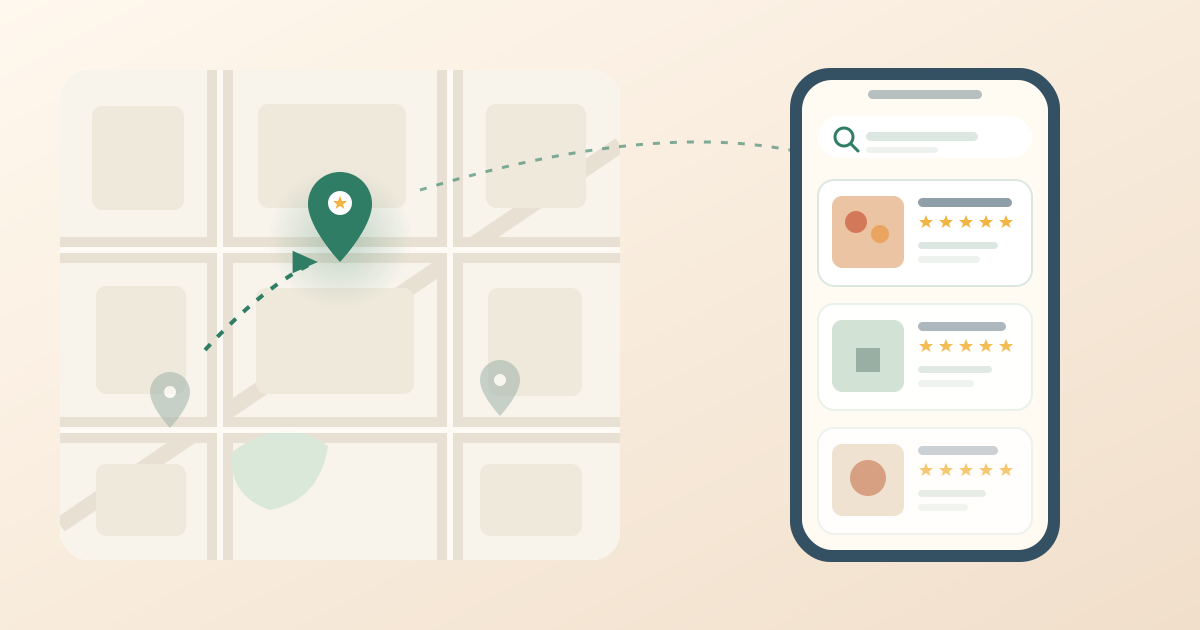
Original illustration created for this article.
Why Your Restaurant Is Missing From the Top of Google Maps
Three patterns show up in almost every restaurant with weak restaurant visibility. The pin sits on page two for searches that should be winnable. Reviews arrive but go unanswered. The social pages look like they were last updated before the pandemic. None of this says anything about the food. It says the digital storefront looks less complete and less active than the one down the street.
The map rewards businesses that appear trustworthy and current. That means the work is concrete: accurate information, steady activity, and real signals from people who have actually been there.
What Actually Drives a Restaurant Google Maps Ranking
Local results are shaped by three broad forces. Understanding them keeps you from wasting effort on things that cannot move.
- Relevance — how closely your profile matches the search. Your categories, attributes, menu language, and even the words guests use in reviews all feed this.
- Distance — how far the searcher is from your location. This is the one factor you cannot change, so the goal is to own your immediate neighborhood rather than chase an entire city.
- Prominence — how established and active you appear. Review volume and responses, fresh photos, posts, local links, and mentions all contribute.
Distance is fixed. Relevance and prominence are where your effort goes, and they are entirely within your control.
12 Fixes That Move Your Pin Up
Work through these in order. The first group takes an afternoon; the rest become a weekly habit.

Original illustration created for this article.
Your Google Business Profile (fixes 1–4)
- Claim and verify the listing you control. An unverified profile cannot be trusted with local visibility. Claim it, complete verification, and make sure no duplicate listing is competing with it. Our Google Business Profile service is built around keeping that foundation accurate.
- Pick the most specific primary category. “Italian Restaurant” beats a generic “Restaurant” when people search for Italian food nearby. Add secondary categories only when they genuinely describe you.
- Fill in every field and attribute. Hours, menu link, reservation and ordering links, payment options, outdoor seating, accessibility. Completeness helps both ranking and the guest’s decision to call.
- Publish a short update every week. Posts about a new dish, a seasonal menu, or an event signal that the business is open and paying attention. Quiet profiles drift.
Reviews and engagement (fixes 5–8)
- Ask for reviews at the right moment. The best time is right after a great experience, not in a generic email blast. Ask consistently, never buy or incentivize reviews.
- Answer every review, especially the hard ones. Calm, specific replies show future diners that someone is listening. That is the core of restaurant reputation management, and it is visible to anyone scanning your listing.
- Answer questions in the Q&A section. Parking, walk-ins, patio rules — clear answers reduce friction and add useful local context to your profile.
- Add new photos on a steady cadence. Food, interior, exterior, and team shots. The exterior photo matters more than owners expect: it helps guests recognize they have arrived.
Local signals beyond the profile (fixes 9–12)
- Keep your name, address and phone number identical everywhere. Your website, directories, and social profiles should match character for character. Inconsistent details split the signals search engines use to confirm you are real.
- Give your restaurant a fast local landing page. Put hours, menu, phone, directions, and structured data on a page that loads quickly on a phone. This is basic local SEO for restaurants and it supports every Maps signal above.
- Earn genuine local mentions. Neighborhood guides, local press, charity sponsorships, and supplier pages carry more weight than stacks of generic directory listings.
- Review your numbers monthly. Track map views, calls, direction requests, and the queries that bring you in. What gets measured is what actually gets improved.
How ForkScale Handles Google Maps Ranking for You
Knowing the 12 fixes is straightforward. Keeping them going while you run a kitchen is not. ForkScale is a restaurant marketing operations platform for North America, built on an AI-assisted, expert-team-led model: one focused team manages your digital presence so you are not juggling multiple logins and a spreadsheet.
The Google Business Profile work covers the listing, its accuracy, and its weekly activity. Local SEO (Website SEO & GEO) strengthens the site structure and local signals behind it. Review responses and social cadence fall under Online Reputation and ongoing care.
The operating sequence stays simple: Free Audit → Strategy → Setup → Optimization → Content & Care → Reports. It is a steady operating system, not a one-time cleanup.
What 500+ Restaurants Have Seen
ForkScale has supported 500+ restaurants across 7+ years of restaurant operations experience, contributing to 20M+ Google views with 95% client retention. Those numbers are not a guarantee of identical results — every neighborhood is different — but they point to a reliable pattern: consistent, accurate local operations compound over time.
Start With a Free Google Maps Visibility Audit
Pick three fixes from this guide and apply them this week. If you would rather have a team own the whole list, ForkScale begins with a free audit that shows where your Google Maps presence is leaking visibility, then maps those gaps to a plan you can maintain. See the services overview or check pricing — Growth at $399 per month is the most popular plan for steady single-location operations, billed monthly with a three-month minimum.
Great food should not be hard to find. Make sure the map agrees.